Passwordless authentication as a security measure
Say goodbye to passwords: The future of secure login with passwordless authentication


Tired of remembering multiple passwords and constantly resetting them? Passwordless authentication is revolutionizing the way we log in to our accounts and provides secure and convenient alternatives to traditional passwords. In this article, you'll learn about the benefits of passwordless authentication and how it's changing our understanding of security.
The use of digital resources is essential in a professional environment; business processes and applications are sometimes completely and exclusively digitally represented. However, as online activity increases, so does the attack surface and the number of cyber attacks and data breaches. One of the most common ways for hackers to gain access to sensitive information is to use passwords.
Traditional login methods, in which users only have to remember and enter a single password, have several weaknesses. One of the main risks is the potential for phishing attacks, where hackers send fake emails or messages that appear legitimate and ask employees to enter their login details. This can result in not only the user's login details but also sensitive personal or financial data falling into the hands of attackers.
Another problem with traditional login methods is that it is all too easy and convenient for employees to choose weak and easy-to-guess passwords. Studies have shown that a significant percentage use the same password for multiple accounts or use easy-to-guess combinations such as “123456” or “password.” This makes it even easier for attackers to gain access to sensitive information.
The evolution of passwordless authentication
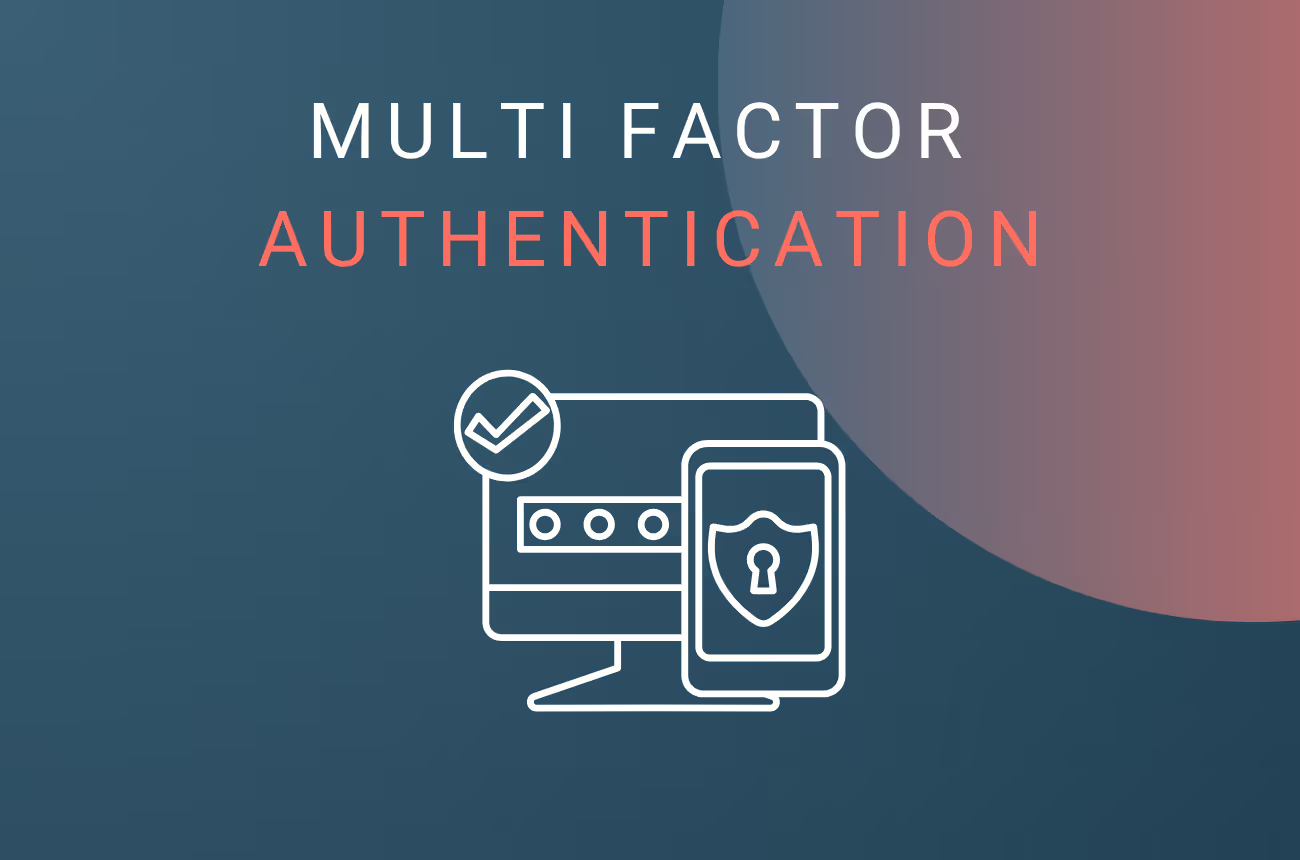
Multi-factor authentication (MFA), an authentication method that requires the use of two or more types of authentication factors to verify a user's identity, is used to secure logins. These factors could be something the user knows (such as a password), something the user has (such as a security key or phone), and something that the user is (such as a fingerprint or facial recognition).
The goal of MFA is to increase security by requiring multiple forms of verification before granting access to an account or system. For example, a user may be asked to enter a password and then confirm their identity with a fingerprint, or receive and enter a one-time passcode that is sent to their phone.
MFA is considered more secure than a simple login, which only relies on one form of verification, such as a password. It makes it difficult for an attacker to gain access to an account even if they are able to obtain a user's password, as they would still have to pass another form of authentication.
However, methods of multi-factor authentication differ enormously in their security, as some procedures also rely on passwords and shared secrets while others enable passwordless authentication. Methods that offer significantly more security than using a single static password are therefore preferred. Several factors are used to unequivocally determine the identity of the user. For example, the “knowledge” factor (password or PIN) is extended by the factor of “ownership” (smartphone, smart card or authentication token). The factors “property” (biometrics) or “behavior” are also playing an increasingly important role.
The development is moving towards completely passwordless authentication, but this is only available if there are no passwords or PINs in the backend. For this purpose, solutions are used that are based on a public key encryption method and usually replace passwords with secure cryptographic, asymmetric key pairs. With such methods, hacker attacks are only possible on individual people and devices, but not on an entire database with numerous login credentials. Biometric data, FIDO2 devices and other strong authentication methods that are not based on conventional passwords are possible here.
Conclusion
Multi-factor authentication is therefore an important part of a holistic security concept in a company. However, MFA is not the same as MFA — a modern passwordless MFA that uses biometric data and device-specific private keys in accordance with the FIDO standard, offers stronger and more usable authentication than traditional MFA solutions, and also minimizes the attack surface of companies.
In addition, there is the current global trend towards more remote work and thus offers increasing market opportunities for password-free solutions. Since many companies are developing a culture of mobile working in the long term, it is more important than ever to provide employees with the tools and resources to travel securely on the Internet — both in their private lives and when working from home.
Contact the Press Team

Lea Stahl
marketing@bare.id